
Dictionary · C
Custody
also: self-custody, custodial, non-custodial
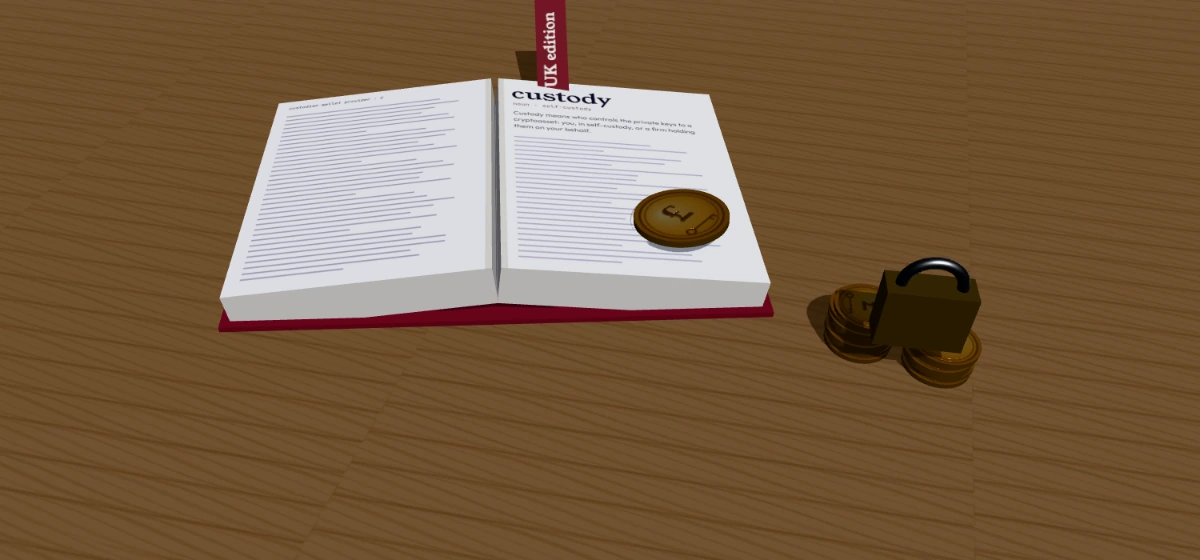
Custody means who controls the private keys to a cryptoasset: you, in self-custody, or a firm holding them on your behalf.
Rules checked against GOV.UK, the FCA and legislation.gov.uk on 17 November 2026. How entries are checked
Who really controls my crypto right now?
Whoever holds the private key can move the coins, so custody is about control rather than whose name is on a screen. Hence the slogan 'not your keys, not your coins': a balance in an app is a promise from a company, while coins in a wallet whose recovery words only you know are under your control alone.
Each option shifts the risk. A firm gives you password resets and a complaints process, but it can fail, freeze or be hacked. Self-custody removes that middleman, and with it every safety net: lose the recovery words and the device together and nobody can help.
Plenty of people mix the two, keeping a small trading balance with a platform and the rest in their own wallet.
Helen keeps £150 on a platform for small trades and £2,000 in her own hardware wallet. If she forgets the platform password, she resets it by email. If she ever lost both the hardware wallet and its recovery words, there would be no one to ring and no reset link.
Not the same as Custodian wallet provider: Custody is the arrangement, meaning who holds the keys; a custodian wallet provider is the registered firm type offering the custodial version.
| Custodial | Self-custody | |
|---|---|---|
| Who holds the private key | A firm | You |
| Forgotten password | Reset by email | Recovery words or nothing |
| What can go wrong | Firm fails, freezes or is hacked | Lose words and device, nobody can help |
| What the UK says | FSCS can't help if a platform fails | A misplaced key isn't a disposal |
This page sets out how custody works rather than telling you which arrangement suits your own money.
What should I set up, whichever way I hold crypto?
- Decide who holds the keys before you send anything, not afterwards.
- With self-custody the backup is your job; test a restore with a small amount.
- Leave your executors a note on where your crypto is, but keep the recovery words out of your will. In England and Wales a will becomes public after probate.
Questions people type about custody
how many words crypto wallet
Self-custody wallets usually give 12 or 24 recovery words. A custodial account gives you none, because the firm holds the keys.
what does not your keys not your coins mean
If someone else holds the private keys, you're relying on them to let you withdraw. It's a reminder about control, not a claim that every platform is unsafe.